


The Architect’s Blueprint for the Agentic Enterprise
Article 3 of 6
The Team: Stop Hiring PhDs. Start Finding People Who Hate Your Expense Report Process.
The $5 Million Mistake
The biggest mistake I see organizations make when building an AI Center of Excellence (CoE) is hiring 5 to 50 AI PhDs and locking them in a room.
They assume that because AI is complex technology, the solution must be complex engineering. So they build a “Lab.” They stock it with brilliant researchers who have published papers on transformer architectures and reinforcement learning.
And that Lab builds incredible prototypes that nobody in the business actually wants to use.
I’ve watched this pattern play out at a Fortune 500 manufacturer. They hired 30 data scientists. Gave them GPUs, Jupyter notebooks, and carte blanche. Six months later, they had:
A brilliant recommendation engine that Sales refused to adopt (it didn’t integrate with their workflow)
An impressive demand forecasting model that Supply Chain couldn’t trust (it lacked explainability)
A sophisticated customer segmentation algorithm that Marketing ignored (it answered questions they weren’t asking)
Beautiful demos. Zero business impact. $5 million budget. Zero ROI.
Here’s the hard truth: AI is no longer a science project. It’s an operations challenge.
If you want to build an Agentic Enterprise, you don’t need a research lab. You need a Hub and Spoke engine. And the most important person in that engine isn’t the one coding the model—it’s the one who hates your current expense report process with a burning passion.
The Structure: Hub vs. Spoke
To balance safety (The Shield) with speed (The Hands), you need to separate duties.
You cannot have a central team trying to write prompts for Marketing, Finance, and HR simultaneously. They don’t have the context. They don’t know that the “Procurement Approval” process has 17 undocumented exceptions that only Susan in Accounting understands.
Conversely, you can’t let Marketing build their own unmonitored agents with access to customer databases and corporate credit cards, or you’ll end up with a PR disaster and a security breach.
You need a Federated Model:
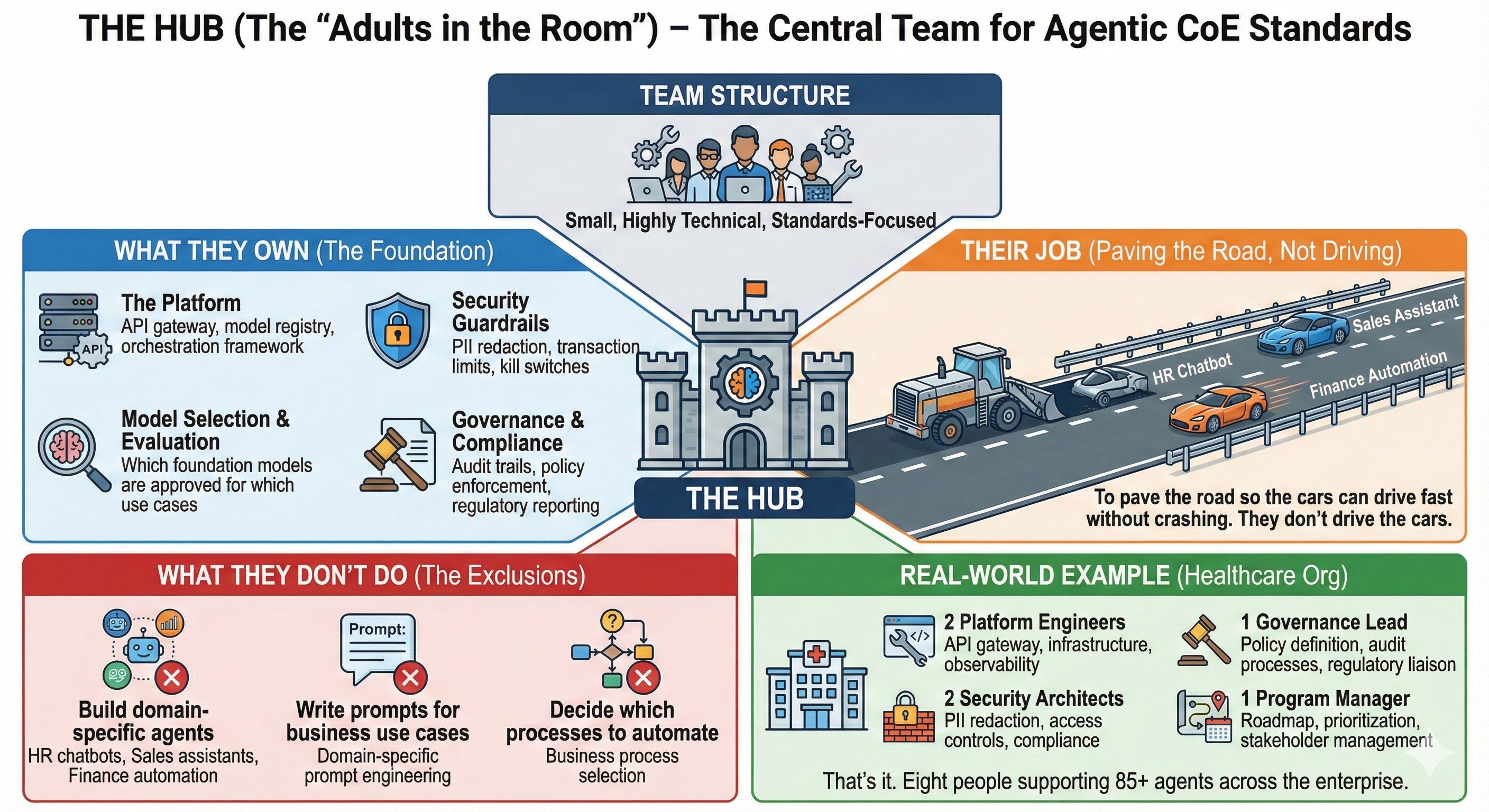
1. The Hub (The “Adults in the Room”)
This is your central team. They are small (5-15 people), highly technical, and focused on Standards.
They Own:
The Platform (API gateway, model registry, orchestration framework)
Security Guardrails (PII redaction, transaction limits, kill switches)
Model Selection & Evaluation (which foundation models are approved for which use cases)
Governance & Compliance (audit trails, policy enforcement, regulatory reporting)
Their Job: To pave the road so the cars can drive fast without crashing. They don’t drive the cars.
What They DON’T Do:
Build domain-specific agents (HR chatbots, Sales assistants, Finance automation)
Write prompts for business use cases
Decide which processes to automate
Real-World Example: When I set up the CoE for a major healthcare organization, the Hub team was 8 people:
2 Platform Engineers (API gateway, infrastructure, observability)
2 Security Architects (PII redaction, access controls, compliance)
2 AI Engineers (model evaluation, RAG infrastructure, prompt engineering frameworks)
1 Governance Lead (policy definition, audit processes, regulatory liaison)
1 Program Manager (roadmap, prioritization, stakeholder management)
That’s it. Eight people supporting 85+ agents across the enterprise.
2. The Spokes (The “Drivers”)
These are your Business Units (HR, Sales, Supply Chain, Finance, Customer Service).
They Own:
The Use Case (which processes to automate)
The Process Design (how the workflow should work)
The Outcome (business metrics and success criteria)
Their Job: To drive the car to a specific destination (e.g., “Reduce invoice processing time by 60%” or “Cut hiring time from 45 days to 20 days”).
What They DON’T Do:
Build infrastructure from scratch
Invent their own security frameworks
Select and deploy foundation models independently
The Model: Each Spoke operates independently with full capability to build agents, but they use the Hub’s infrastructure, follow the Hub’s governance standards, and leverage the Hub’s reusable patterns.
But Here’s Where Most Companies Fail
The “Spoke” teams usually lack the technical skills to build agents. The “Hub” teams lack the business context to know what to build.
So you get:
Hub builds solutions nobody wants (because they’re guessing at business requirements)
Spokes can’t execute (because they don’t have AI/ML expertise)
Nobody talks to each other (because incentives aren’t aligned)
To fix this, you need a “Power Couple.”
The Secret Weapon: The GPO and The GSO
I borrowed this concept from the Oracle Playbook, and it’s the single most effective organizational hack for scaling AI that I’ve seen.
Oracle didn’t just throw AI at their problems. They paired two specific roles for every major function:
1. The Global Process Owner (GPO)
This is a senior business leader—not IT—who owns the “To-Be” process.
The Profile:
Deeply understands the current process and its pain points
Knows where the bodies are buried (undocumented workarounds, shadow IT, manual hacks)
Has authority to redesign the process, not just automate it
Usually frustrated with the status quo
Has skin in the game (their bonus depends on process efficiency)
The Mandate: “Simplification.” Their job isn’t to automate the mess; it’s to clean it up first.
Key Insight: The GPO’s power comes from their ability to say “We don’t need AI for this—we need to eliminate this step entirely.”
Example: When Oracle’s HR GPO looked at the hiring process, they didn’t ask “How can AI approve these faster?” They asked “Why do we need 12 layers of approval in the first place?” They eliminated 70% of approval steps before deploying any AI.
2. The Global Solution Owner (GSO)
This is the IT/Architecture counterpart mapped to the GPO.
The Profile:
Solution architect who understands AI capabilities (what’s possible vs. what’s hype)
Technical depth in integration, APIs, data architecture
Can translate business requirements into technical specifications
Partners with the Hub to leverage platform capabilities
Focuses on enablement, not gatekeeping
The Mandate: “Enablement.” Their job is to translate the GPO’s vision into technical reality using the Hub’s infrastructure.
Key Insight: The GSO doesn’t build everything from scratch. They leverage the Hub’s pre-built components (API connectors, guardrails, orchestration templates) and customize for the Spoke’s specific use case.
Example: When Oracle’s Finance GPO wanted to accelerate planning cycles, the GSO didn’t build a custom AI model. They configured Oracle’s existing AI features, integrated with the planning data sources, and deployed using standardized governance frameworks.
Why This “Power Couple” Works
The GPO defines WHAT needs to be done (Business Intent)
The GSO defines HOW the agent will do it (Technical Execution)
Without the GPO, you get technically brilliant solutions that solve the wrong problem.
Without the GSO, you get great ideas that never get implemented.
Together, they create a closed feedback loop:
GPO simplifies the process (removes unnecessary complexity)
GSO builds the agent (automates what remains)
GPO measures business impact (hours saved, errors reduced, satisfaction improved)
GSO iterates based on operational data (what’s working, what’s not)
Repeat
Real-World Proof: How Oracle Saved 20,000 Hours Annually
Let’s look at a concrete example of this “Power Couple” in action.
The Problem
Oracle’s internal HR team wanted to fix their hiring process. It was slow (45+ days to fill a role), bureaucratic (12 layers of approvals), and painful for managers, candidates, and recruiters alike.
The Old Way (The Trap)
A standard “lift and shift” approach would have been to build a chatbot that answers questions like “What is the status of my application?” or “Who needs to approve this next?”
This is a Level 1 Copilot. It helps, but it doesn’t solve the core problem. The issue isn’t understanding the process—it’s that the process itself is broken.
The GPO Move: Simplify First
The HR GPO (a business leader, not IT) looked at the process and realized the bottleneck wasn’t “answering questions”—it was approvals.
Every hire required:
Department head approval
Budget approval
Headcount approval
Compliance review
Compensation approval
Senior leadership sign-off
(and 6 more layers depending on role/level)
The Bold Decision: They didn’t just automate the approvals. They eliminated 70% of them.
How? By:
Pre-approving budget for open requisitions (no re-approval needed for posted roles)
Delegating compensation approval to hiring managers within bands
Automating compliance checks using existing data (no manual review for standard roles)
Removing redundant sign-offs (if budget owner approved, skip department head)
Result: 12 approval steps → 4 approval steps.
The GSO Move: Automate What Remains
Then, the GSO (the technical partner) deployed agents to handle the remaining logistics:
Agent 1: Candidate Matching
Used AI-based “Suggested Candidate” and “Similar Candidate” features
Helped recruiters identify suitable candidates faster
Reduced manual screening time by 40%
Agent 2: Offer Orchestration
Automated offer letter generation
Coordinated multi-party approvals (the 4 remaining steps)
Triggered background checks and onboarding workflows
Sent automatic status updates to candidates
Agent 3: Onboarding Automation
Provisioned accounts (email, laptop, systems access)
Scheduled orientation sessions
Sent welcome packets
Enabled new hires to contribute on Day 1
The Results
Quantitative Impact:
20,000 manager hours saved annually on hiring process
70% reduction in time needed to complete talent review process
Recruitment time cut dramatically (specifics vary by role, but 30-50% faster on average)
2x increase in qualified applicants per requisition (better candidate experience)
24-hour onboarding for 20,000+ new hires per year
Qualitative Impact:
Managers stopped complaining about hiring bureaucracy
Candidates had better experience (faster response, clearer communication)
HR team could focus on strategic talent initiatives instead of administrative work
The Key Lesson
Notice the sequence:
Simplify (GPO eliminated 70% of approvals)
Automate (GSO deployed agents for remaining steps)
Measure (20,000 hours saved)
If they’d reversed the order and automated the 12-step approval process, they would have achieved marginal gains (maybe 10-15% faster). By simplifying first, they achieved transformational gains (50%+ faster).
This is why you need GPOs, not just data scientists.
The Federated Model in Practice
Here’s what the Hub and Spoke model looks like operationally:
Hub Responsibilities
Platform & Infrastructure:
API gateway with authentication, rate limiting, audit logging
Model registry (approved models: GPT-4 for reasoning, Claude for long context, Llama for cost-sensitive use cases)
RAG infrastructure (vector databases, embedding models, retrieval pipelines)
Workflow orchestration framework (LangChain, Semantic Kernel, or custom)
Standards & Patterns:
Seven reusable agent patterns (Data Analyst, Document Processor, Service Orchestrator, Watchdog, Modernizer, Inspector, Workflow Augmenter)
Template prompts and workflows for common use cases
Integration blueprints for top 20 enterprise systems (Salesforce, SAP, Workday, ServiceNow, etc.)
Governance & Security:
PII/HIPAA redaction layer
Transaction limits and approval gates
Confidence thresholds for escalation
Kill switch capability
Compliance reporting dashboards
Success Criteria for Hub:
Time to deploy a new agent (Target: <30 days from concept to production)
Reusability rate (Target: >60% of agents use pre-built components)
Security incidents (Target: Zero governance breaches)
Spoke Responsibilities
Use Case Identification & Prioritization:
GPO identifies high-pain, high-impact processes
GPO defines success metrics (hours saved, errors reduced, satisfaction improved)
GPO prioritizes based on business value and feasibility
Process Redesign:
GPO simplifies workflow before automation (eliminate unnecessary steps)
GPO documents “To-Be” process with clear decision points
GPO defines escalation rules (when to route to human)
Agent Development:
GSO translates process into technical specification
GSO leverages Hub’s platform and reusable components
GSO customizes for Spoke-specific requirements (domain language, integrations, workflows)
Adoption & Change Management:
GPO drives adoption within their domain (training, communication, incentives)
GPO collects feedback and identifies improvement opportunities
GPO measures business impact and reports to leadership
Success Criteria for Spoke:
Adoption rate (Target: >70% of eligible users within 90 days)
Autonomy rate (Target: >80% of workflows complete without human intervention)
Business impact (Target: ROI positive within 6 months)
Actionable Advice: Go Find Your GPOs
If you’re building your CoE team today, stop looking for more Prompt Engineers.
Go find the person in Finance who complains the loudest about how hard it is to close the books.
Go find the Sales Director who creates their own shadow-IT spreadsheets because the CRM is too slow.
Go find the HR Manager who manually tracks every hire in an Excel file because the ATS doesn’t do what they need.
Those are your Global Process Owners.
For your convenience… Here are the Oracle Playbook Reference Links:
1. The Oracle Playbook for AI Excellence
URL: https://www.oracle.com/a/ocom/docs/gated/oracle-ai-excellence-playbook-ebook.pdf
2. The Oracle Playbook for IT Systems Excellence
URL: https://www.oracle.com/a/ocom/docs/gated/oracle-playbook-it-systems-excellence-ebook.pdf
What Comes Next
You’ve got the framework (3 dimensions of maturity). You’ve got the team (Hub and Spoke with GPO-GSO pairs).
Now you need the methodology.
In Article 4, we’ll dive into the three-step process these teams should use: “Streamline, Empower, Delight.”
Because here’s the reality: If you automate a bad process, you just get bad results faster. The GPO’s first job is simplification. The GSO’s job is enablement. And both must obsess over user experience, because if people don’t trust and adopt your agents, none of this matters.
That’s what we’re tackling next.
Here are the links to your blueprint
Article 1: The 3-dimensional maturity model (Brain, Hands, Shield)
Article 2: The 5 levels of autonomy (Copilot → Autopilot)
Article 3: The team structure (Hub-and-Spoke, GPO-GSO pairs)
Article 4: The methodology (Streamline, Empower, Delight)