


Here’s what nobody tells you about thriving in the age of AI: The most valuable skill isn’t technical. It’s a mindset—a mental model, a systems thinking approach.
It’s not about learning Python, mastering prompt engineering, or getting certified in the latest framework. Those matter. But they expire.
The skill that compounds? Tolerance for uncertainty. Experiment rapidly. Learn patterns and pivot quickly.
Over years building my career in AI and solution architecture, I realized: The people who succeed aren’t the ones who know the most. They’re the ones comfortable learning in the fog—who can say “I don’t know” without their confidence collapsing.
When Satya Nadella took over Microsoft in 2014, he bet the entire company—$300 billion—on this same insight.
The Crisis: When “Knowing” Nearly Killed Microsoft
When Nadella became CEO in 2014, Microsoft was culturally dying:
Missed cloud computing while Amazon built AWS
Missed mobile while Apple and Google dominated
Employees hoarded information to protect themselves
Teams competed internally rather than collaborated
Stack-ranking pitted colleagues against each other
The problem wasn’t capability. It was the capacity to handle ambiguous problems.
Microsoft operated on a “know-it-all” mental model—where expertise meant having answers, where admitting uncertainty was career suicide, where annual plans were locked in regardless of market feedback.
Sound familiar? It’s the default mode of most organizations. Hollywood personifies leaders who are decisive, have executive presence, exercise judgment with passion. Saying “I don’t know” feels like career suicide.
Being Decisive vs Handling Unknown Risks
I learned this the hard way. I was once accused of being “undecisive” for advocating more testing before launching an automation agent into production.
The Director was adamant: “Go live now. The agent has built-in intelligence to self-heal.”
I pushed back: “What about edge cases we haven’t tested?”
His response? “You’re overthinking it. We should be decisive in going live as soon as possible.”
The know-it-all mental model: We frame situations based on what we want to see, with strong recency bias, ignoring black swan risks. We optimize for looking decisive over being right.
The Revolution: From “Know-It-All” to “Learn-It-All”
Nadella’s revolution was a mental model shift:
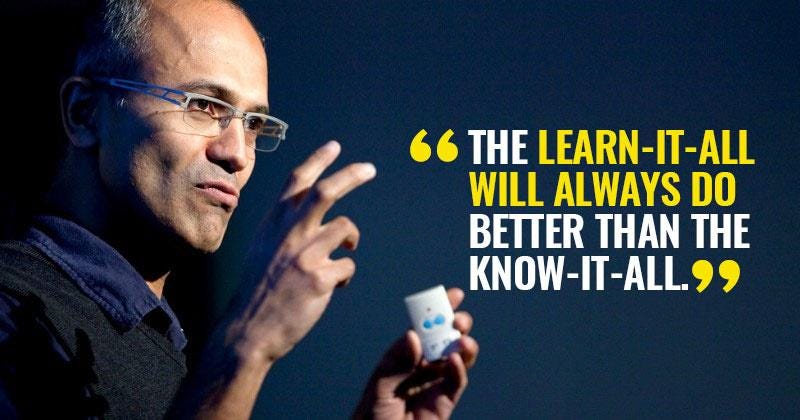
“Don’t be a know-it-all, be a learn-it-all.”
What this means in practice:
Experiment rapidly: Run small tests, don’t wait for perfect information
Learn patterns: Extract transferable lessons from each experiment
Pivot quickly: Adjust when the system gives you feedback
Nadella operationalized this with concrete changes:
Replaced annual budgets with rolling forecasts
When markets shift quarterly, 12-month plans are expensive theater. Rolling forecasts say “Here’s our hypothesis today—we’ll adjust as we learn.”
Eliminated stack-ranking
When helping colleagues hurts your ranking, you hoard knowledge. Nadella killed it immediately. Individual genius is less valuable than collective learning velocity.[see microsoft]
Monthly “Ask Me Anything” sessions
The CEO of a $300B company saying “I don’t know, but here’s how we’ll figure it out.” That’s leadership in uncertainty.
Made “growth mindset” a performance metric
Reviews now ask: “How did you help teammates grow? What did you learn? How did you adapt when wrong?” Message: We value learning over knowing.
The Result: $2.7 Trillion in Proof
Microsoft went from stagnant $300B to the world’s most valuable company at $3 trillion.
Not because they knew more than competitors. Because they built a system that learned faster in uncertainty.
When AI emerged, the mental model transferred:
Partnered with OpenAI (experiment rapidly)
Integrated AI across products (learn patterns)
Adjusted strategy monthly (pivot quickly)
Competitors debated 5-year AI strategies. Microsoft shipped, learned, iterated.
That’s the power of the right mental model.
Why This Matters for Your Career
The same dynamics killing Microsoft are killing careers now.
Most people operate “know-it-all”:
❌ Wait for the “right” certification
❌ Hoard knowledge as competitive advantage
❌ Stick to 5-year plans despite market feedback
❌ Perform certainty when confused
While they wait, the world moves. Jobs disappear. Skills commoditize. Plans obsolete.
Systems thinkers operate “learn-it-all”:
✅ Experiment rapidly with small bets
✅ Share learning publicly
✅ Extract transferable patterns
✅ Pivot based on feedback
Not smarter. Just operating with a mental model designed for uncertainty.
The Career Math
Know-it-all approach:
Wait 6 months for AI certification
Spend $5,000 on courses
Framework changes before you’re “ready”
Result: 6 months behind, still uncertain
Learn-it-all approach:
Spend this weekend building something small with AI
Share what you learned and what confused you
Connect with 5 people ahead of you
Iterate based on feedback
Result: 52 iterations in 6 months, dozens of relationships, real capabilities
Which person gets hired?
In Part 2, I’ll show you the exact learning system that shifted me from know-it-all to learn-it-all—and led to career job offers including my current Principal AI Solution Architect role.
Your homework:
Spend 4 hours learning something that intimidates you
Write 200 words about what confused you
Post it publicly
Don’t wait to “know enough.” Start learning. Publicly. Imperfectly.
Drop a comment: What’s one thing you’re waiting to “know enough” about before starting?
In a world of exponential change, the learning system beats the knowing system every time.
The question is: Which system are you building?
References
Microsoft. (2025). “Digitally transforming Microsoft: Our IT journey.” Microsoft Inside Track Blog. https://www.microsoft.com/insidetrack/blog/digitally-transforming-microsoft-our-it-journey/
Reddit. (2021). “How Satya Nadella Transformed Microsoft and its Engineering Culture.” r/ExperiencedDevs. https://www.reddit.com/r/ExperiencedDevs/comments/nzuypt/how_satya_nadella_transformed_microsoft_and_its/
Loi, N. (2025). “Satya Nadella’s quote: Don’t be a know-it-all, be a learn-it-all.” LinkedIn. https://www.linkedin.com/posts/nina-loi-56209161_leadership-growthmindset-innovation-activity-7351632788762087424-_Unj
Best Form Consulting. (2025). “Leading Through Uncertainty.” https://www.bestformconsulting.com/leading-through-uncertainty.html
Tatia, A. (2024). “How Satya Nadella transformed Microsoft.” LinkedIn. https://www.linkedin.com/posts/aasthatatia_leadershipdevelopment-leadership-satyanadella-activity-7198960522271105024-aWRt
Fortune. (2024). “Satya Nadella transformed Microsoft’s culture during his decade as CEO.” https://fortune.com/2024/05/20/satya-nadella-microsoft-culture-growth-mindset-learn-it-alls-know-it-alls/