

The Meaning Gap: Why Technically Correct AI Gets Quietly Abandoned
I proposed a talk. Not because I had a polished deck. Because I had field notes.

I’ve been sitting with a problem for a long time.
Not a technical problem. A human one.
I’ve watched enterprise AI deployments fail — not at the model level, not at the infrastructure level — but at the moment of contact with the organization that was supposed to use it. The agent was correct. The outputs were accurate. The demo was clean. And then it hit production — and within 90 days, adoption collapsed. Quietly. Without a postmortem. Without anyone saying out loud what actually happened.
I started calling this the Meaning Gap.
The distance between what an AI system does and what an organization believes it means — for their jobs, their judgment, their identity, their accountability. When that gap is wide, it doesn’t matter how good your model is. The system gets rejected. Not loudly. Quietly. Death by non-adoption.
What crystallized it for me
For the past 12 weeks I’ve been teaching graduate students at UT Dallas. Every Saturday morning. Six students building coding agents from scratch.
What I kept watching wasn’t a technical failure. It was a meaning failure. Students would build something that worked — technically sound, architecturally clean — and then struggle to explain why anyone should trust it. Not because the agent was wrong. Because they hadn’t built the operating model around it. No evaluation framework. No trust scaffolding. No answer to the question every end user is silently asking: what does this mean for me?
That pattern — technically correct, humanly irrelevant — is what I’ve been seeing in production deployments for years. My students just made it visible in slow motion.
The talk
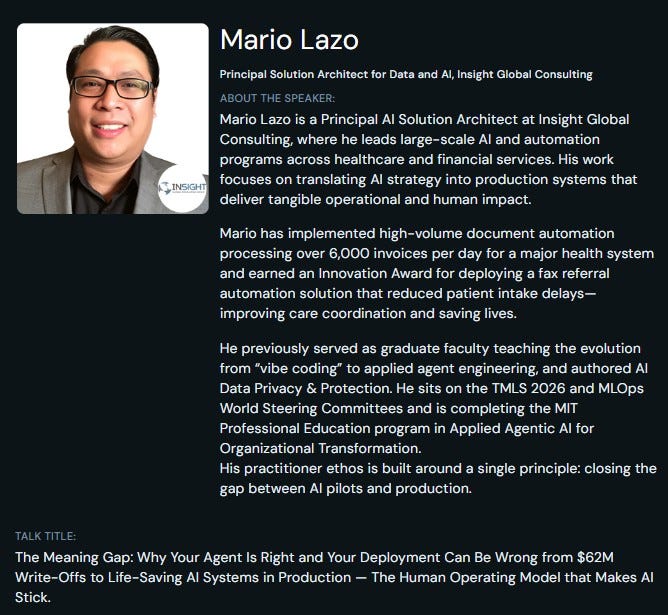
In June 2026 I’ll be on stage at TMLS presenting:
“The Meaning Gap: Why Your Agent Is Right and Your Deployment Can Be Wrong.”
I proposed it not because I had a polished deck. Because I had field notes. And because David Scharbach posted a gap in the TMLS program that matched exactly what I’d been quietly researching.
But here’s what I don’t want to do: walk onto that stage with only my own field notes.
What I need from you
Before I finalize this talk I want to hear from real practitioners. Not the conference version. The hallway version. The one nobody records.
Three questions:
1. What’s the most surprising reason you’ve seen an AI deployment fail in production? Not technical. Human.
2. When you hand off an agent to a business unit, what’s the one thing you wish they understood before day one?
3. Is the Meaning Gap real in your organization — and where does it show up first?
The best talks aren’t written alone. They’re built from a hundred conversations with people who were actually there.
I want yours.
Mario