


In Article 1, we covered the mental model shift that transformed Microsoft: from “know-it-all” to “learn-it-all”.
Now let’s get practical. How do you actually experiment rapidly when you’re working full-time?
This is Year 1 of my transformation—how small, fast experiments built momentum. No 5-year plan. Just rapid testing, learning, and adjusting.
The Context: Stuck in “Know-It-All” Mode
Several years ago, I was stuck. Watching colleagues get promoted while I spun my wheels.
My instinct? Wait for the perfect move.
“I’ll learn AI when it’s clear which framework wins”
“I’ll start writing when I have something important to say”
“I’ll take on that stretch project when I’m 90% sure I can succeed”
Classic know-it-all thinking: Wait for certainty, then act.
The problem: By the time you have certainty, the opportunity is gone.
So I made a terrifying decision: What if I stopped optimizing for promotions and started building capabilities through rapid experiments?
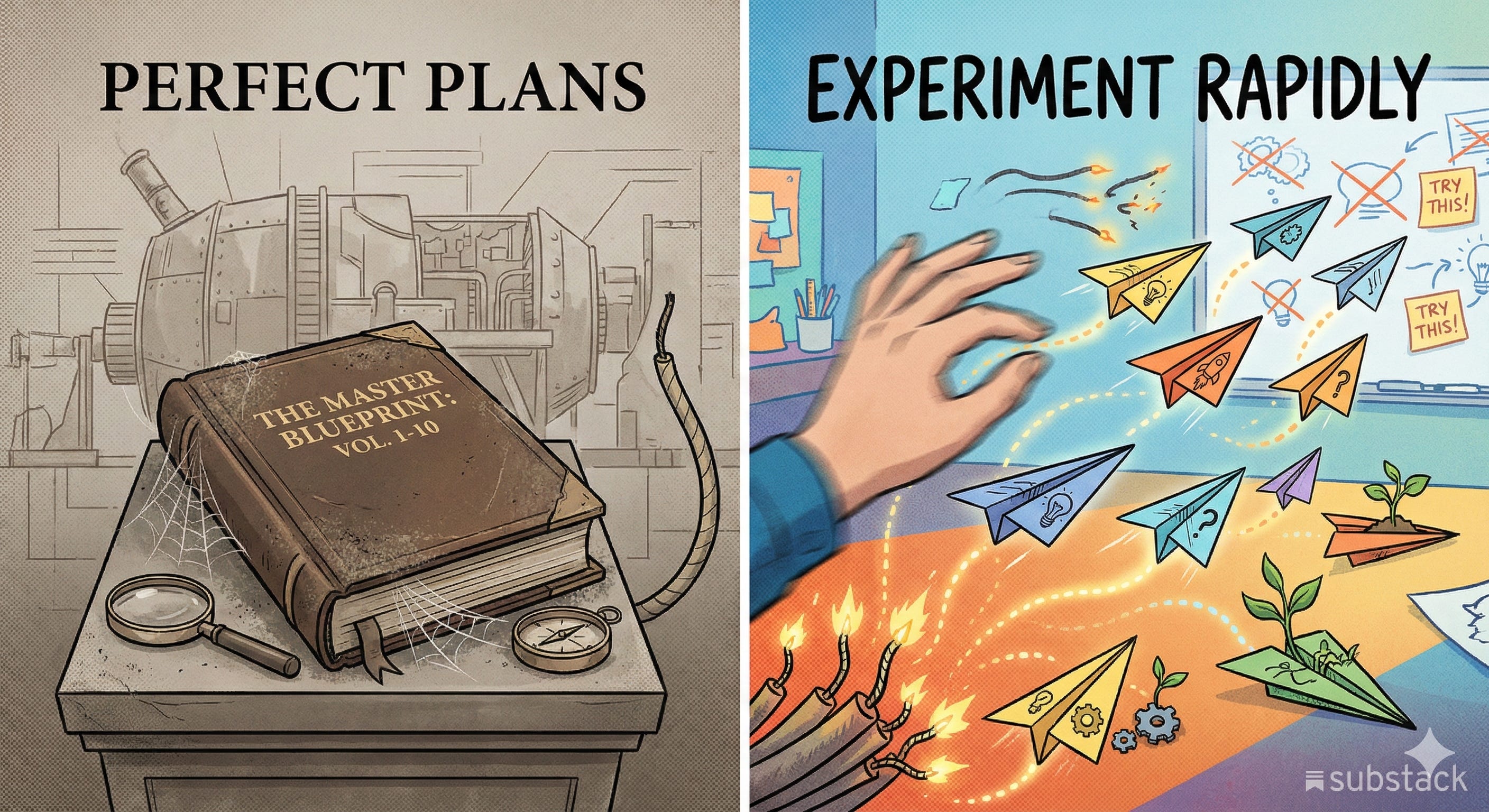
The Saturday Morning Experiment (8-12 Months of Iteration)
The hypothesis: If I spend weekends learning AI/LLM architecture without a clear plan, I’ll discover opportunities I can’t see from where I’m standing.
The commitment: Saturdays 9 AM - 1 PM, learning something that scared me. Not for 4 weeks. For 8 months.
Month 1-2: LLM Fundamentals
Free tutorials didn’t work. I barely understood them until I attended MLOps conferences. Hearing experts explain concepts with real use cases—everything clicked. I kept attending, kept asking questions.
Month 3-4: Build a RAG System
It barely worked, then broke. I consulted friends who showed me what tutorials left out—the edge cases, the debugging, the “oh yeah, that always breaks” tribal knowledge. I iterated, broke it again, fixed it again.
Month 5-6: Fine-Tuning Models
Complete failure. Gibberish output. I partnered with a startup whose CEO - Founder -data scientist in one, showed me what I was doing wrong—dataset too small, hyperparameters nonsense, wrong evaluation metrics. We worked through it together over weeks. We even presented a demo.
Month 7-8: Research Papers
Impenetrable at first. Then I found the MLOps community’s paper reading series. People walked through papers line by line, explaining unstated assumptions. I attended every session, asked every stupid question.
The fear (that lasted months): “I’m wasting weekends. My colleagues are relaxing. Am I being stupid?” At times, I feel like burning out when the weekday workload was intense and I am laboring over weekends.
The Feedback (After Months of Showing Up)
Month 4: Posted privately about my broken RAG system on LinkedIn and Substack → 5 DMs from people facing similar problems. A friend sent YouTube videos that gave me the solid understanding I couldn’t get from documentation alone.
Month 6: Wrote about what confused me in research papers → A VP of Engineering at a bank had the same problems. He commented, shared insights. We started a conversation.
Month 8: Weekend learning led to a free consulting opportunity with a startup founder who has a PhD in Generative AI. I hosted him in my community. We talked until 1 AM about how gen AI actually works—the real mechanics, not the sanitized tutorial version.
The pattern: The compound effect took time. Month 1 felt like nothing. Month 4 brought small wins. Month 8 created real opportunities.
What I Learned
Free tutorials alone don’t work. You need context—conferences, communities, conversations with practitioners.
Consistency beats intensity. Research on learning shows that distributed practice over time produces better long-term retention than cramming. Eight months of Saturday mornings beat two weeks of all-nighters.
Failure is the feedback. As systems thinking teaches us, feedback loops are how complex systems improve. My broken RAG system taught me more than a working one would have.
Learning in public attracts help—but slowly. First posts: crickets. Month 4: people started engaging. Month 6: real conversations began.
Communities accelerate everything—if you show up repeatedly. The MLOps community didn’t trust me immediately. But after 8 weeks of showing up, asking questions, and sharing learnings—I became part of it.
I learned that I didn’t have to be the smartest person in the room. What I developed was tenacity—the conviction that I can solve any challenging problem when I’m part of a broader data and AI community. We pull for each other. We share our struggles. We celebrate small wins together.
That became incredibly motivational and inspirational. Not the lone genius model Hollywood sells us, but the collective learning model that actually works. When you’re stuck at 11 PM on a Saturday and someone in the community DMs you a solution they figured out last month—that’s the compound effect of community.
The pivot: Double down on learning in public. Share confusion, not conclusions. Hunt for experts. Build relationships through curiosity, not performance. And be patient—compound effects take months, not weeks.
The deeper insight: You don’t need to be brilliant. You need to be consistent, curious, and connected. The community makes you smarter than you could ever be alone.
References
Microsoft. (2025). “Digitally transforming Microsoft: Our IT journey.” Microsoft Inside Track Blog. https://www.microsoft.com/insidetrack/blog/digitally-transforming-microsoft-our-it-journey/
Loi, N. (2025). “Satya Nadella’s quote: Don’t be a know-it-all, be a learn-it-all.” LinkedIn. https://www.linkedin.com/posts/nina-loi-56209161_leadership-growthmindset-innovation-activity-7351632788762087424-_Unj
Wenger, E. (1998). Communities of Practice: Learning, Meaning, and Identity. Cambridge University Press.
Cepeda, N. J., et al. (2006). “Distributed practice in verbal recall tasks: A review and quantitative synthesis.” Psychological Bulletin, 132(3), 354-380.
Meadows, D. H. (2008). Thinking in Systems: A Primer. Chelsea Green Publishing.
Clear, J. (2018). Atomic Habits: An Easy & Proven Way to Build Good Habits & Break Bad Ones. Avery.
Ericsson, K. A., Krampe, R. T., & Tesch-Römer, C. (1993). “The role of deliberate practice in the acquisition of expert performance.” Psychological Review, 100(3), 363-406.